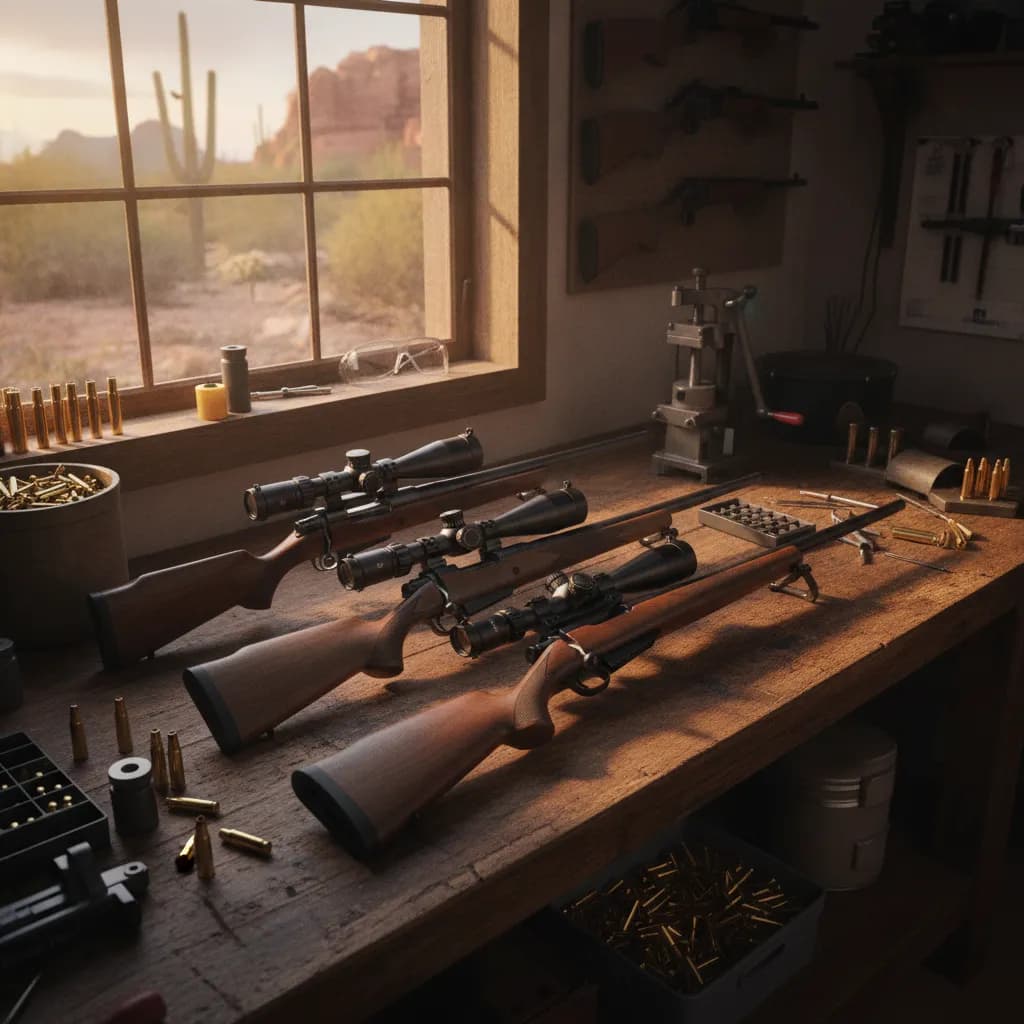
How a Mesa-based hunting outfitter's 19 approved builds reveal a shop betting heavily on the 7mm and 6.5 PRC boom.
Precision Hunting Supply's Build Sheet Is a Bet on the PRC Cartridge Family
Nineteen approved builds and a nine-to-five hunting-to-PRS split tell a clear story: this Mesa shop has bet its bench time on the PRC cartridge family and the mountain hunter who wants a turret dialed past 800 yards.
A Catalog Built Around Two Cartridges
Better than half of PHS's current build sheet runs some flavor of the PRC cartridge family — this is a shop built around Hornady's newest architecture, not a general-purpose custom house.
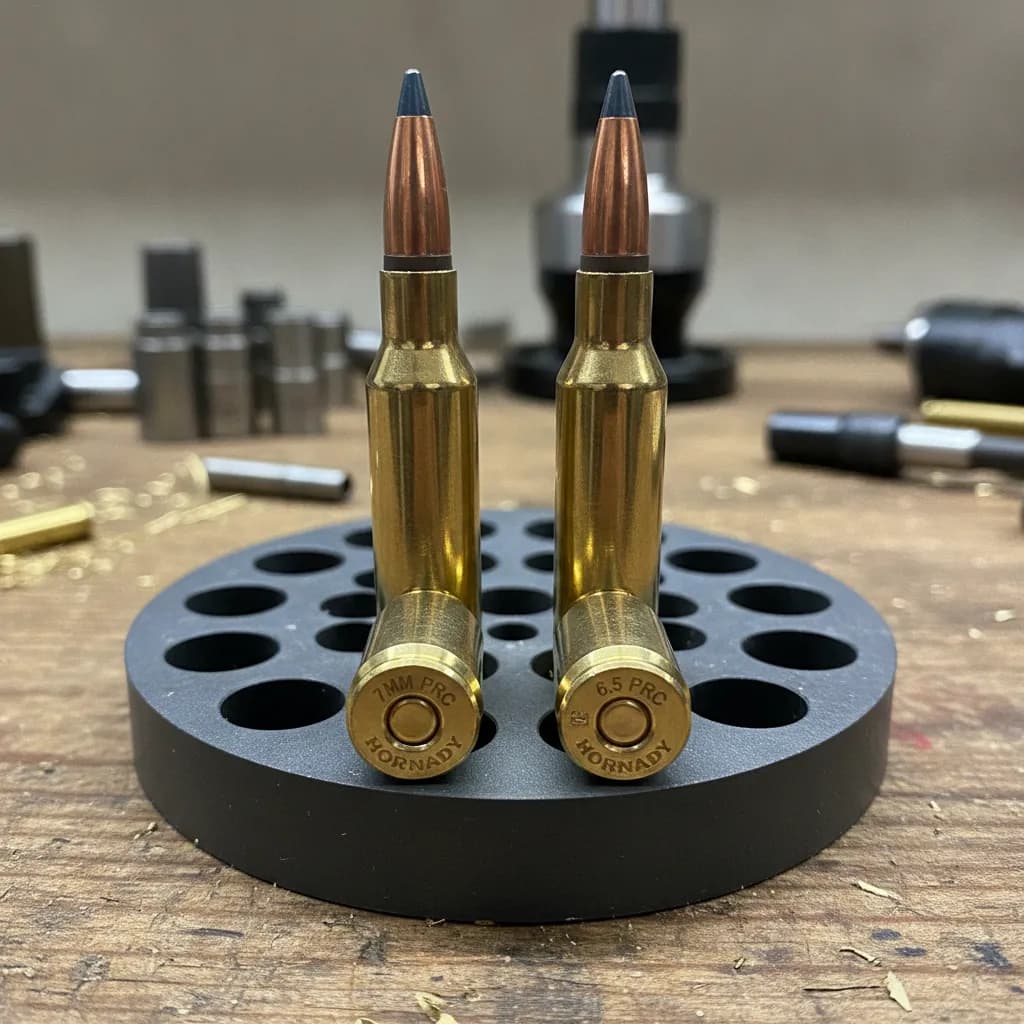
Look at the nineteen rifles Precision Hunting Supply currently has approved and a pattern jumps out immediately: this is not a shop chasing chambering variety for variety's sake. Seven of the seventeen builds — better than 40 percent of the entire current lineup — are chambered in 7mm PRC, and five more sit in 6.5 PRC. Between those two cartridges alone, PHS has committed 70 percent of its build sheet to Hornady's PRC-family case architecture. Add the two 300 PRC builds and you're at nine of seventeen rifles, or better than half the shop's output, running some flavor of PRC.
That's a meaningfully different signature than what you'd see from a PRS-oriented custom house, where 6mm Creedmoor, 6 Dasher, and 6mm GT typically dominate build sheets because those cartridges trade a bit of terminal energy for flatter recoil impulse and longer barrel life across the thousands of rounds a competition shooter fires each season. PHS's mix instead mirrors what's happened on the hunting side of the industry over the past few years: mainstream production houses — Ruger, Bergara, Seekins, Sig, Springfield — have all rolled PRC-family chamberings into their standard catalogs within a remarkably short window, and PHS's approved-rifle list reads like a snapshot of that adoption curve. You can see it directly in builds like the Seekins Precision PH3 7 PRC and the PHS SEMI CUSTOM 7 PRC, both sitting squarely in that mainstream 7mm PRC lane.
The remaining chamberings on the sheet — 22 Creedmoor, 25 Creedmoor, and a single Creedmoor entry outside the PRC family — read less like a competing strategy and more like a boutique sideline. One-off builds like the PHS/Axis Works Custom 25 Creedmoor and the Bergara Sierra Wilderness 22 Creedmoor suggest PHS is willing to entertain flatter-shooting, lower-recoil options for hunters who prioritize precision over knockdown power, but these remain outliers rather than a second pillar of the business.
Systems Integrator, Not Barrel-and-Action Gunsmith
To understand why PHS's caliber mix looks the way it does, you have to understand what kind of builder they actually are. PHS doesn't primarily cut chambers and thread barrels in-house the way a traditional custom shop does. Their business runs on three parallel tracks: an in-stock "Current Rifle Builds" program where they configure ready-to-ship rifles on factory and semi-custom actions, a bespoke "Build to Suit" quoting process, and an "Accurizer Services" line that takes a customer's existing rifle and re-tunes it into what they call a dependable long-range shooting system. That's a systems-integrator model, closer to a high-end retailer-outfitter hybrid than a Bartlein-and-Krieger custom house.
That model explains the donor-action diversity you see across the approved list: Fierce Carbon, Seekins Havak and PH3, Sig Cross Sawtooth, Ruger American Gen II, Springfield Waypoint 2020, and multiple Bergara platforms all show up as the underlying rifle, with PHS's value-add layered on top as tuning, load development, and — critically — optics integration. The Sig Sauer Cross Sawtooth 300 PRC and Seekins Precision Havak PH3 300 PRC are good examples of this pattern: strong factory-semi-custom donor rifles that PHS finishes into a hunting-ready package rather than actions machined from a blank in their own shop.
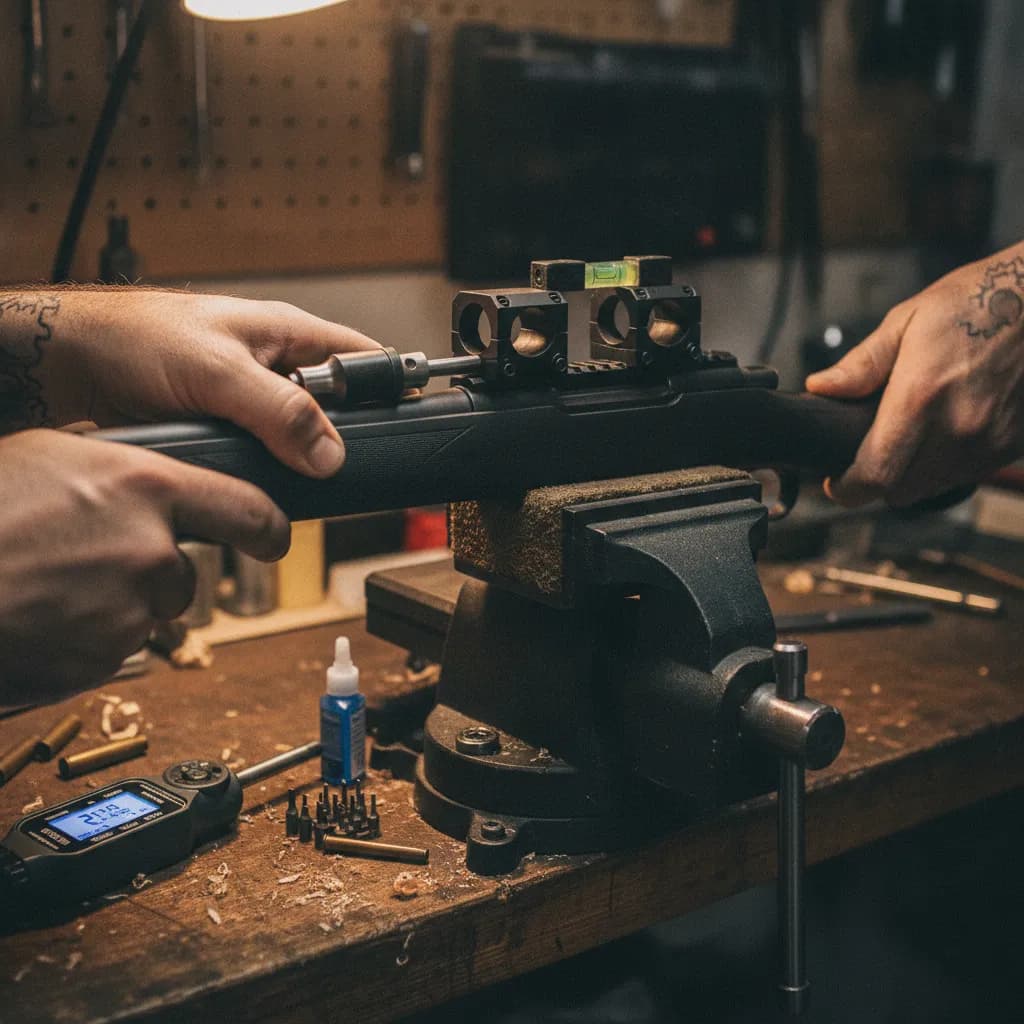
Optics selection reinforces this positioning. PHS's named glass partners — Huskemaw, Nightforce, Leupold, Swarovski, and GPO — lean toward ballistic-turret hunting scopes designed around a custom drop-compensated dial rather than the mil/mil first-focal-plane glass that dominates PRS competition setups. That's a deliberate choice consistent with a shop whose average verified MOA sits at 0.582 — tight enough to be genuinely useful at extended hunting ranges, but not chasing the sub-0.3 MOA benchmarks that pure competition builders publicize. A hunter dialing a Huskemaw turret to 900 yards on a mule deer doesn't need benchrest-grade repeatability; they need a rifle that holds zero across a pack-out and a scope that gets them on target fast in changing light.
Reading the Use-Case Split: Hunting-First, Competition-Adjacent
The use-case tagging across the current catalog — fourteen hunting-oriented builds against nine tagged for PRS competition — tells you PHS is primarily serving big-game hunters who want long-range capability, with a meaningful secondary audience of PRS-curious shooters who may be using the same rifle for both practical hunting and local match days. That 14-to-9 split (note some rifles carry both tags) isn't a even a coin flip; it's roughly 60/40 in favor of hunting, and given the caliber mix skews so heavily toward magnum-class PRC cartridges, that ratio makes sense. A 7mm PRC or 6.5 PRC build is a genuinely capable PRS gun on paper, but the felt recoil and barrel-life economics make it a less obvious choice for a shooter firing 150+ rounds in a single competition weekend compared to a 6mm-class rig.
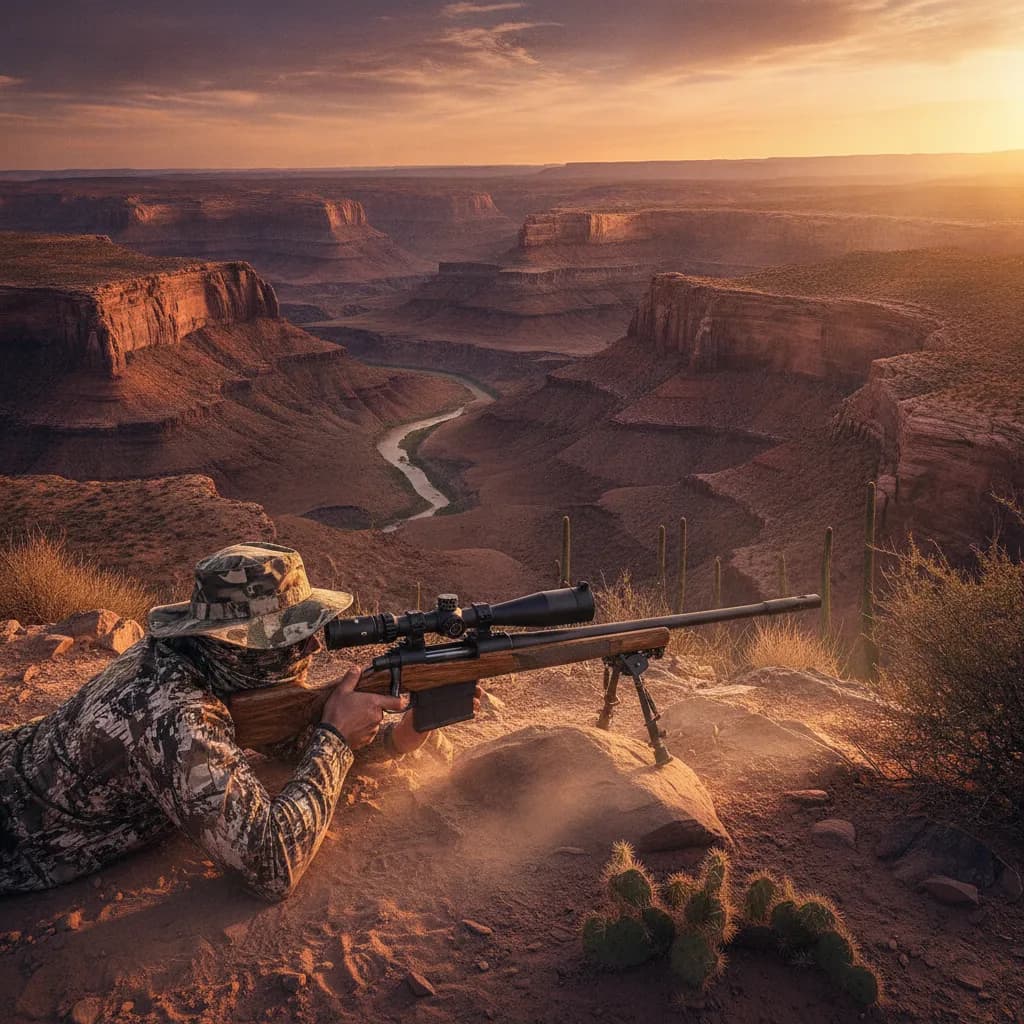
What this tells prospective buyers is that PHS's specialty tag — Hunting Specialist — isn't just marketing copy layered on top of a generic build sheet; it's borne out in the actual chambering and use-case data. If you're shopping for a dedicated PRS rig built around minimizing recoil across long strings of fire, PHS's current inventory isn't the strongest fit. But if you're a mountain hunter who wants a rifle that can also see occasional match duty — one that shoots inside 0.6 MOA on average and is chambered in a cartridge with genuine flat-trajectory performance past 700 yards — their current lineup, including builds like the PHS/Axis Works Custom 25 Creedmoor for hunters wanting reduced recoil without abandoning PRC-adjacent ballistics, is squarely built for that customer.
The founder badge and verified tier on PHS's builder profile also matter for buyers weighing lead time against reputation. Founder status typically signals platform tenure rather than build volume alone, and with all seventeen current rifles listed for sale simultaneously, PHS appears to be running inventory-forward rather than strictly build-to-order — a detail that should shorten effective wait times relative to bespoke custom shops quoting individual actions from scratch, though buyers should still confirm current turnaround directly given lead-time data isn't uniformly published across builder tiers on the platform yet.
What the Unverified MOA Figures Actually Mean
A close reading of the approved-rifle sheet shows something worth flagging honestly: of the seventeen builds, only six carry a verified MOA figure. The rest — including both 25 Creedmoor entries, the Curtis Custom X-Lite 7 PRC, and several Bergara and Seekins builds — are listed as unverified. That's not necessarily a knock on build quality; it more likely reflects the practical reality that a shop running an inventory-forward, ready-to-ship model doesn't always have a documented range session on file for every configuration before it's listed. The six verified figures that do exist — ranging from 0.418 MOA on the Fierce Carbon Rogue 6.5 PRC down to 0.79 MOA on the Ruger American Gen II 7 PRC — average out to 0.582 MOA, which is a solid, field-credible number for hunting-weight barrels and factory-derived actions, even if it wouldn't turn heads in a pure PRS build survey.
Buyers evaluating PHS against other verified-tier builders should weigh that unverified proportion carefully. It's not a red flag on its own, but it does mean roughly two-thirds of the current catalog is asking for a degree of trust on accuracy claims rather than offering documented proof. The tightest verified performer in the current lineup, the Fierce Carbon Rogue at 0.418 MOA, suggests the ceiling on PHS builds is genuinely competitive when the donor action and barrel combination line up well — the question for a prospective buyer is less whether PHS can build an accurate rifle, and more whether they'll get documentation on the specific configuration they're ordering.
Taken together, the aggregate picture is consistent rather than scattered: a hunting-first shop, heavily invested in the 7mm PRC and 6.5 PRC boom, operating as an integrator of strong semi-custom donor actions rather than a from-scratch gunsmithing house, delivering field-solid accuracy in the mid-0.5 MOA range, with documentation that trails the build volume. For the mountain hunter chasing flat trajectories at extended range, that's a builder whose current body of work is speaking clearly about where its strengths lie.