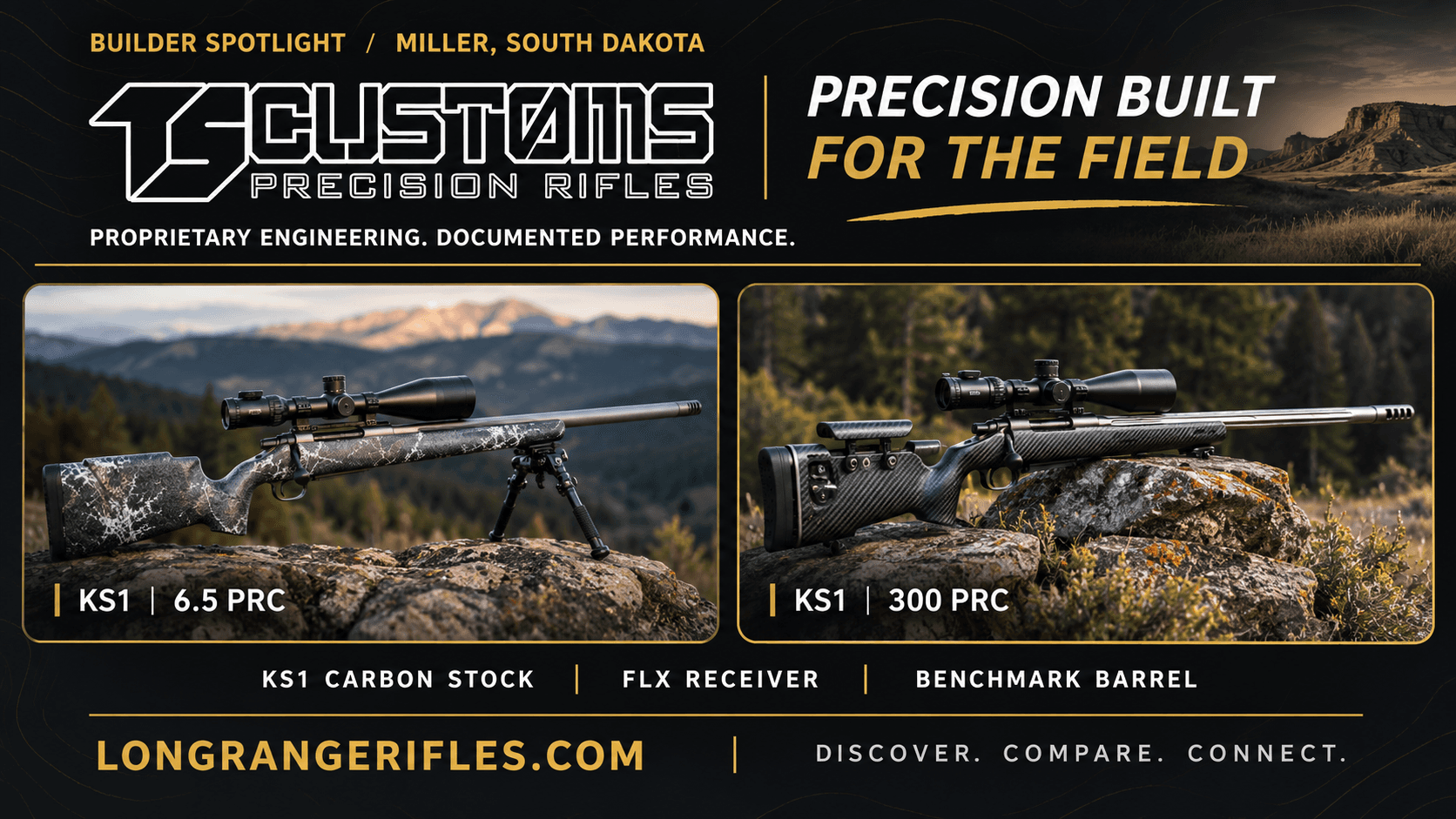
FROM THE PROPRIETARY KS1 STOCK AND FLX RECEIVER TO EXCEPTIONAL DOCUMENTED ACCURACY, TRAVIS STEVENS HAS BUILT TS CUSTOMS INTO A DISTINCTIVE NAME IN PRECISION RIFLES.
TS Customs: Inside the South Dakota Rifle Builder Redefining the Modern Hunting Rifle
Inside TS Customs of Miller, South Dakota, where proprietary rifle components, competition-inspired engineering, and documented precision come together in a growing portfolio of custom long-range hunting rifles.
Written by LRR.com
November 10, 2026 | 9 min read
PURPOSE-BUILT IN MILLER, SOUTH DAKOTA
In the increasingly crowded world of custom precision rifles, it’s easy to find builders promising exceptional accuracy, premium components, and meticulous craftsmanship.
It’s considerably harder to distinguish which companies are genuinely developing their own products, refining their manufacturing processes, and producing rifles that deliver consistent results beyond a single impressive target.
TS Customs, headquartered in Miller, South Dakota, offers a compelling case study.
Founded and led by Travis Stevens, the company has spent more than 15 years developing precision rifles for hunters and competitive shooters. What began with the craftsmanship and technical expertise of a custom rifle builder has evolved into an operation producing its own receiver platform, proprietary carbon-fiber stocks, and complete rifle systems.
Its reputation extends into the competitive shooting community, but its current LongRangeRifles.com showroom tells a particularly interesting story about the direction of its rifle-building business.
With 32 registered builds, TS Customs carries Benchmark status and a displayed average accuracy of 0.165 MOA.
Nearly every rifle in that collection is configured for hunting.
That combination—competition-influenced precision, proprietary components, and an unmistakable emphasis on field rifles—is what makes TS Customs worth examining.
Explore the TS Customs showroom on LongRangeRifles.com
A HUNTING-RIFLE PORTFOLIO WITH COMPETITION ROOTS
Among the 32 rifles cataloged on LongRangeRifles.com, the overwhelming majority are designated for hunting. The current registry breakdown identifies 30 hunting builds, one ELR build, and one PRS competition build.
That’s a remarkably concentrated collection for a company that also identifies itself as a competition specialist.
But the distinction deserves context.
The LRR registry is a collection of rifles the builder has chosen to document. It is not necessarily a complete production history, an order book, or a direct measurement of customer demand.
What it does reveal is how TS Customs has elected to present its capabilities.
The company’s featured rifles lean heavily toward hunting configurations built around precision actions, premium barrels, carbon-fiber stocks, and cartridges suited to a wide range of field applications.
That approach isn’t inconsistent with a competition background. In fact, it’s a logical extension of it.
Competition shooting rewards repeatability, precise rifle control, effective recoil management, and predictable point of impact. Those same characteristics become especially valuable in a hunting rifle when a shooter may have only one opportunity under less-than-ideal field conditions.
The challenge is incorporating those characteristics without turning a practical hunting rifle into an unnecessarily heavy competition platform.
TS Customs has approached that problem by developing components specifically around the needs of the precision-minded hunter.
THE KS1: MORE THAN ANOTHER CARBON-FIBER STOCK
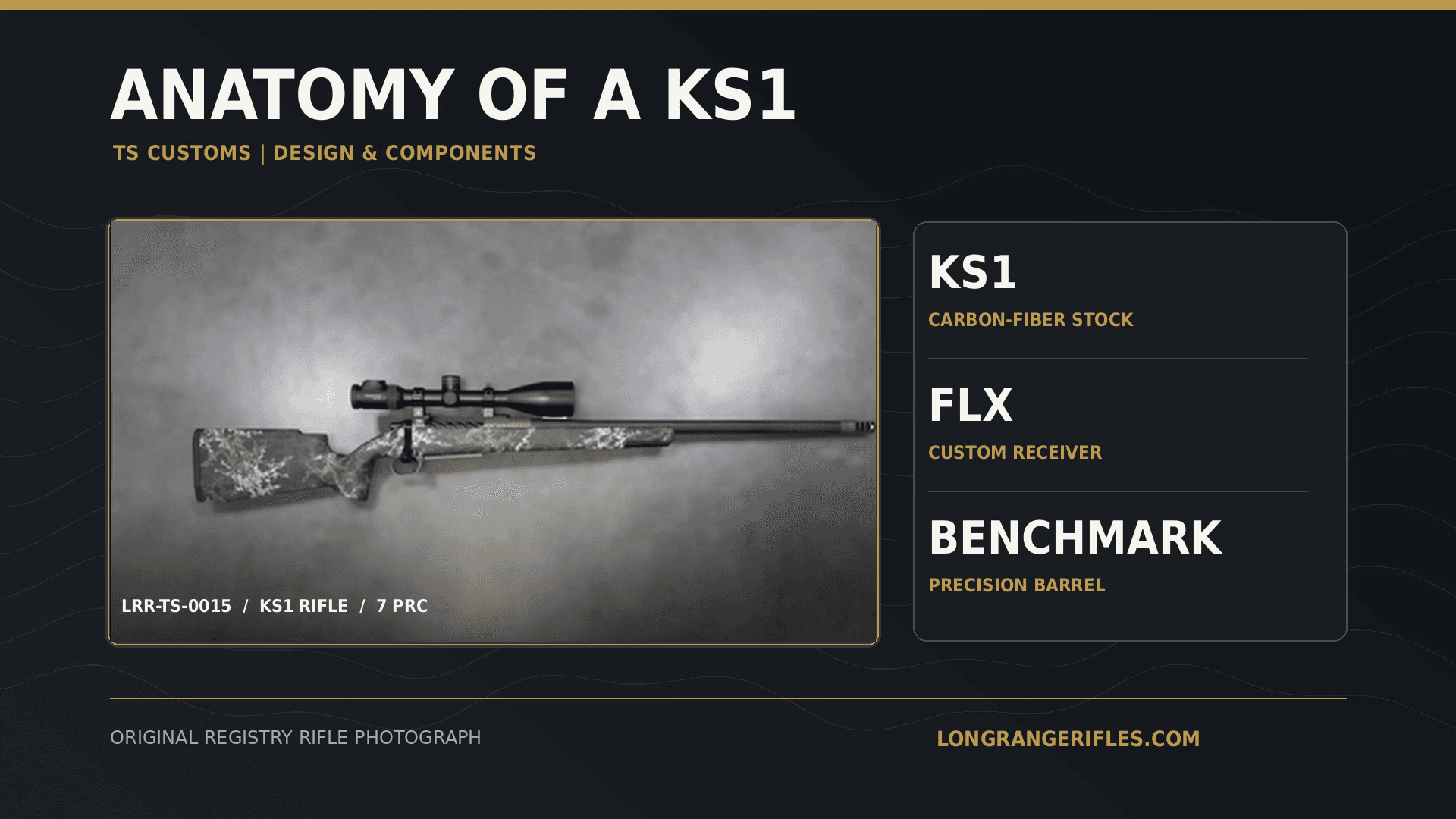
One of TS Customs’ most important developments is its proprietary KS1 carbon-fiber rifle stock.
Rather than relying exclusively on existing stock manufacturers, Stevens developed a design intended to address the geometry and recoil-management requirements of lightweight precision hunting rifles.
The KS1 features a relatively vertical grip positioned closer to the trigger, a high straight comb, minimal drop at the recoil pad, and an elongated, slender fore-end with an integrated bipod mounting interface.
These aren’t merely cosmetic features.
Grip geometry influences how naturally the shooter’s trigger hand aligns with the trigger. Comb height affects cheek placement and consistency behind the optic. Recoil-pad position and stock geometry can influence how predictably a rifle moves under recoil.
Meanwhile, an extended fore-end and properly positioned bipod provide a stable support arrangement without requiring the dimensions of a full competition chassis.
According to TS Customs, the standard KS1 weighs approximately 27 ounces, while the adjustable version weighs approximately 42 ounces, depending on configuration.
Those figures place the stock squarely in the conversation for hunters seeking a relatively lightweight rifle without abandoning the ergonomics associated with precision shooting.
The company also offers numerous finishes and customization options, giving the KS1 a recognizable visual identity.
More importantly, the design is not limited to TS Customs’ own finished rifles. KS1 stocks are also offered through industry component suppliers, extending the company’s presence beyond its gunsmithing operation.
A custom rifle builder that develops and distributes its own recognizable stock platform occupies a different position from one that simply selects components from a catalog.
Explore the KS1 stock on the TS Customs website
THE FLX RECEIVER: ANOTHER PIECE OF THE EQUATION
The KS1 is only part of TS Customs’ proprietary component strategy.
The company also offers its FLX precision rifle receiver, a lightweight stainless-steel action designed around the familiar Remington 700 footprint.
The FLX incorporates a two-lug bolt with a 75-degree lift, a low-angle extractor, and a tool-free firing-pin removal system.
These features address practical considerations ranging from bolt manipulation and optic clearance to maintenance and reliability.
A receiver’s design alone does not establish the accuracy of a completed rifle. Barrel quality, chambering, bedding, ammunition, and final assembly remain important contributors.
Nevertheless, developing a receiver allows a builder to exercise greater control over one of the most important mechanical components in the system.
TS Customs reports using the FLX in the majority of its current builds, frequently pairing it with Benchmark barrels and its KS1 stock.
That combination creates a recognizable foundation across many of the rifles shown in the LRR registry.
It also helps explain the company’s transition from a custom gunsmith assembling individualized rifles to a manufacturer with identifiable signature products.
There is still considerable flexibility.
TS Customs works with other respected component manufacturers and builds rifles around customer preferences when appropriate. The company’s registry includes rifles using alternative stock designs, including McMillan, demonstrating that its proprietary components have not replaced customer-specific customization.
The result is a business offering both a signature rifle platform and the flexibility traditionally associated with boutique custom gunsmithing.
INSIDE THE LRR SHOWROOM: WHAT THE NUMBERS REVEAL
A closer look at TS Customs’ 32 registered rifles provides several insights into its cartridge preferences and documented performance.
The collection covers everything from traditional small-bore varmint cartridges to modern PRC chamberings and larger magnum hunting rifles.
The 6.5 PRC and 7 PRC appear repeatedly, alongside the 22 Creedmoor, 25 Creedmoor, 300 PRC, 300 Winchester Magnum, and several less-common chamberings.
But perhaps the most unexpected development is the concentration of rifles chambered in 220 Swift.
THE UNEXPECTED 220 SWIFT CLUSTER
Seven of the 32 rifles in the registry are chambered in 220 Swift.
That makes the Swift the largest individual cartridge group in the collection, representing approximately 22% of the registered builds.
For a cartridge introduced in the 1930s, that’s an interesting level of representation in a modern custom-rifle portfolio.
The 220 Swift established its reputation through high velocity and a relatively flat trajectory. Although newer cartridges have attracted much of the attention in precision shooting, the Swift continues to appeal to enthusiasts of predator and varmint rifles.
TS Customs’ treatment of the cartridge is particularly interesting because it places an established chambering within a modern precision-rifle platform.
Consider the KS1 Rifle in 220 Swift — LRR-TS-0017.
This hunting rifle combines the FLX action, KS1 stock, TriggerTech trigger, and a 20-inch Benchmark barrel with a 1:12 twist rate.
The result is a compact, contemporary interpretation of a classic high-velocity cartridge.
The abundance of Swift builds suggests that TS Customs sees value in supporting chamberings outside the most popular contemporary offerings.
However, the reason for the concentration remains unconfirmed. These listings may represent customer commissions, completed examples, or deliberate efforts to showcase available configurations.
The registry alone cannot establish how many Swift rifles the company sells annually.
And there is an important performance-data limitation: the individual Swift listing examined does not yet include verified accuracy data.
The rifles demonstrate configuration capability. Their performance should be assessed separately as supporting records become available.
THE PRC BUILDS: WHERE THE ACCURACY DATA GETS INTERESTING
While the Swift collection provides a distinctive angle, the PRC rifles offer some of TS Customs’ most compelling documented performance.
Several KS1 builds combine the company’s FLX action and stock with Benchmark barrels and carefully selected hunting components.
The results recorded in the LRR showroom include some exceptionally small groups.
KS1 7 PRC — LRR-TS-0032
This rifle combines an FLX receiver, a 22-inch spiral-fluted Benchmark Light Magnum barrel, a KS1 stock, TriggerTech trigger, and Swarovski Z5+ optic.
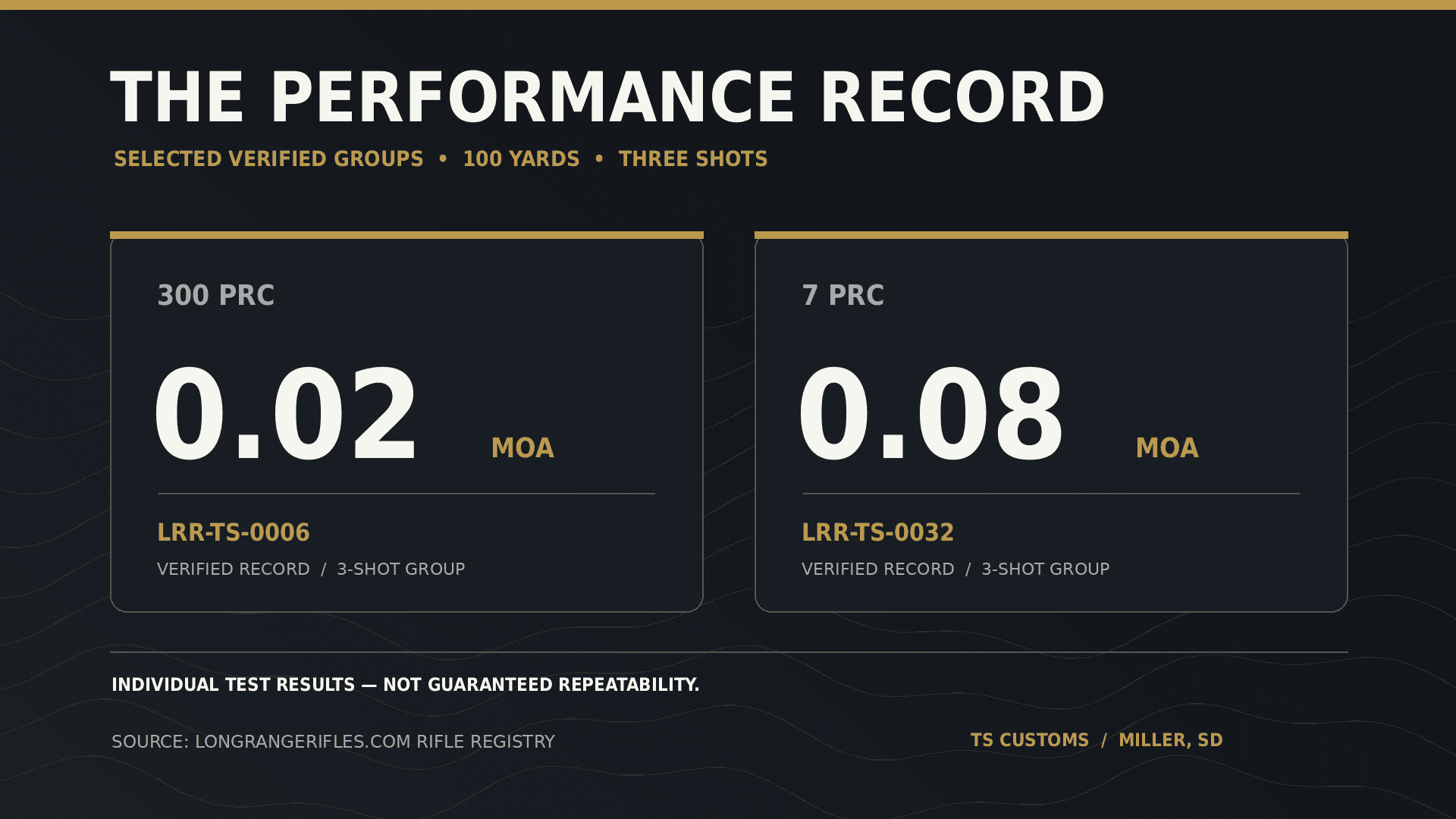
The listing reports an overall weight of 8.9 pounds and includes a verified three-shot group measuring 0.08 MOA at 100 yards using a 175-grain Berger Elite Hunter projectile.
It’s an exceptionally tight group from a configuration intended for hunting.
What makes the rifle notable is the combination of its recorded accuracy and its relatively manageable field weight, rather than either number considered independently.
KS1 6.5 PRC — LRR-TS-0005
Another useful example is this 6.5 PRC KS1, featuring a 22-inch Benchmark barrel and a listed weight of 7.5 pounds.
Its registry entry includes a verified 0.09 MOA three-shot group at 100 yards.
The 6.5 PRC has become a widely adopted cartridge for precision-oriented hunting rifles, offering a useful combination of high-BC projectile options and external-ballistic performance.
This build illustrates how TS Customs applies its signature platform to a cartridge suited to hunters prioritizing both portability and performance at distance.
KS1 22 Creedmoor — LRR-TS-0008
The 22 Creedmoor represents a different application.
This rifle uses an 18-inch Benchmark carbon Sendero barrel, the FLX action, KS1 stock, and a Swarovski Z5+ optic.
Its record includes a verified 0.14 MOA three-shot group at 100 yards.
The shorter barrel and compact configuration distinguish it from the larger magnum hunting rifles in the collection.
Together, these builds show that TS Customs is not dependent on one cartridge or barrel format to produce encouraging precision results.
THE 300 PRC GROUP THAT DESERVES ATTENTION — AND CONTEXT
Among the most remarkable results in the TS Customs registry is the KS1 Rifle in 300 PRC — LRR-TS-0006.
The rifle features a TS Customs FLX action, 24-inch Benchmark Light Magnum barrel, KS1 stock, Leupold Mark 5 optic, and TS Customs Ghost Brake.
Its performance history includes a verified three-shot group displayed at 0.02 MOA at 100 yards, along with additional documented results.
That is an extraordinary reported measurement.
However, it needs to be interpreted correctly.
A three-shot group provides a limited snapshot of a rifle and ammunition combination under a particular set of conditions. The smaller the group, the more consequential measurement precision and sampling become.
A tiny three-shot cluster does not establish that the rifle will repeatedly produce the same result over five-shot or ten-shot strings, different environmental conditions, or extended barrel life.
Nor should a single exceptional group be used to establish the company’s overall reputation.
The more relevant question is whether similarly strong results appear across multiple rifles and repeated tests.
For TS Customs, the registry provides some encouraging supporting examples.
The builder’s current LongRangeRifles.com profile reports an average accuracy of 0.165 MOA. That is impressive, but it represents the platform’s submitted and displayed accuracy data, not a guarantee of performance from every rifle produced.
The distinction matters because not all 32 rifles have comparable verified testing records.
TS Customs has achieved Benchmark status on LongRangeRifles.com, and the performance documentation contributes meaningful evidence for prospective buyers to examine.
As the registry expands, additional five-shot groups, repeated tests, and cold-bore records would make the accuracy picture even more informative.
INDEPENDENT REVIEWS ADD SOMETHING THE REGISTRY CANNOT
Accuracy figures are valuable. But independent accounts of long-term rifle ownership can reveal characteristics that a single group measurement cannot.
In September 2026, Long Range Only published a three-year review of a TS Customs 6.5 PRC hunting rifle.
The author documented nearly 300 rounds fired over several years, including range testing, field use, and shooting at extended distances.
The review described consistent cold-bore behavior, reliable operation, and continued accuracy across the rifle’s use.
The rifle was also taken to a mile during a range session, where the author reported five consecutive hits following an initial miss.
Perhaps more importantly, the review addressed details that are sometimes overlooked in promotional material: stock fit, balance, magazine behavior, the quality of bedding, and continued access to the builder for customer service.
Read the September 2026 Long Range Only review
Another useful evaluation comes from Western Hunter, where Colton Bagnoli reviewed a TS Customs KS1 chambered in 300 PRC.
Bagnoli examined the rifle’s component selection, custom stock design, bedding, and manufacturing quality, highlighting the attention given to the interface between the action and the stock.
Read the Western Hunter KS1 300 PRC review
These reports are not controlled laboratory comparisons, and they represent individual rifles rather than a statistically representative sample.
Nevertheless, they offer something genuinely useful: documented ownership experience beyond a builder’s own accuracy claims.
WHAT SHOOTERS ARE SAYING ABOUT TS CUSTOMS
TS Customs has also developed a recognizable reputation in online precision-rifle communities.
Discussions on Long Range Hunting, Sniper’s Hide, and Reddit contain accounts from customers who have commissioned complete rifles, purchased chambered barrels, or returned to the company for additional work.
Recurring themes include craftsmanship, bedding quality, communication, and the willingness to accommodate individualized builds.
A 2022 Long Range Hunting forum discussion describes a repeat customer receiving a third TS Customs rifle, praising the quality of the work and the company’s communication.
More recent discussions on Sniper’s Hide include recommendations from experienced shooters who have purchased multiple TS Customs barrels.
These are individual customer accounts, not independently audited satisfaction statistics. Positive forum commentary should not be treated as proof that every customer has the same experience.
But the consistency of the themes across different shooting communities and over multiple years is worth recognizing.
For prospective buyers, reputation matters most when it is accompanied by specific examples of work, demonstrated performance, and documented service history.
TS Customs has accumulated evidence in all three areas.
THE OTHER DIFFERENTIATOR: A BUILDER WILLING TO EDUCATE
Another interesting part of TS Customs’ development is its investment in technical content.
Its website publishes articles on cartridge selection, barrel-length performance, projectile design, and precision-rifle considerations.
Recent subjects include 22 Creedmoor performance, monolithic bullets in the 7 PRC, and barrel length versus velocity in the 7 PRC.
This content has practical value beyond attracting website visitors.
Custom rifle buyers frequently face decisions involving cartridge selection, barrel length, weight, recoil, ammunition availability, and intended shooting distance.
A knowledgeable builder should be able to explain the tradeoffs instead of simply recommending the most powerful cartridge or most expensive component available.
TS Customs describes its process as beginning with a conversation about the customer’s intended use.
The company’s technical writing supports that positioning and gives prospective customers a way to evaluate its thinking before commissioning a rifle.
Explore TS Customs’ technical articles
WHERE TS CUSTOMS STANDS TODAY
The custom-rifle industry has no shortage of builders offering premium actions, carbon barrels, elaborate finishes, and impressive accuracy claims.
What distinguishes TS Customs is the combination of several elements.
It has developed recognizable proprietary products rather than relying exclusively on third-party components.
Its KS1 stock addresses the practical challenges of balancing lightweight construction with precision-rifle ergonomics.
Its FLX receiver provides a signature mechanical foundation for a substantial portion of its rifles.
Its manufacturing philosophy emphasizes chambering, bedding, and individual component fit, with a long-standing relationship with Benchmark Barrels.
Its registered portfolio shows considerable cartridge flexibility, including a surprising concentration of 220 Swift builds and a strong representation of the PRC family.
And its reputation is supported by a combination of documented rifle builds, accuracy records, independent reviews, and years of customer discussion.
None of that means every TS Customs rifle should be expected to shoot 0.165 MOA, nor does the registry reveal the company’s complete annual production or customer-order distribution.
It does establish that TS Customs has developed a substantial body of work worth examining.
For hunters evaluating a premium custom rifle, the most important questions remain practical: How well does the rifle fit the intended application? How repeatable is its performance? How does it handle in field positions? And how effectively does the builder support the finished product?
TS Customs’ current record gives prospective customers a meaningful starting point for answering those questions.
With 32 registered rifles, Benchmark status, proprietary components, and a documented history extending well beyond the company’s LRR showroom, Travis Stevens and his team have established TS Customs as a serious contender in the custom precision hunting-rifle market.
Explore the complete TS Customs showroom on LongRangeRifles.com to examine its registered rifle builds, review available accuracy records, and compare its designs with other verified precision-rifle builders.